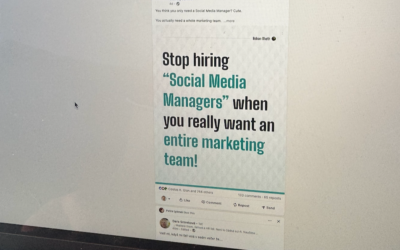

This is 1.
published excerpt from the upcoming book How LinkedIn Will Change Your Life.
It focuses on successful posts on this network: “In order to get someone to talk to you, it is usually worthwhile to “pre-heat” them.
To do that, they need to read your posts.
You can publish these on your LinkedIn company page, on your personal profile, in a group, etc.
You can’t do that in an event.
On the page and in the group it has (as of March 2023) a multiply smaller effect.
Let’s talk about posts on your personal profile. Pragmatic optics: the reader only likes himself.
He cares about his professional success.
He cares about having less work and more money.
If we don’t help him do that, he won’t buy anything.
Not our product, not our service, not our work or our job. Romantic optics: I would hardly deny the above.
However, there is a little something in addition to that: trust and personal affection.
Maybe they’ll believe you’re cool.
But are you really good partners?
That’s why the humanity of your communication matters.
So what topics to choose for posts?
TOPIC 1: “Can you believe what happened to me at work yesterday?”
Be specific.
What was the problem, how did you solve it?
TOPIC 2: “The 5 most common mistakes you make when (…)” Here’s something you’re good at.
That’s why you can predict the mistakes others make in it.
And advise them on how to avoid such an outburst.
TOPIC 3: “Do you also think that (…)? Well, that’s not true.”
You have the reader’s attention.
Now you can’t mess it up.
(Further topics will be part of the book)  Post Processing Now, it’s very simple: a typical good post has a plot at the beginning, followed by the core message, and then, then comes the denouement. And you know what happens to most authors and why their posts fail despite good content?
Yes, they have neither a plot nor a denouement.
Want an example?
Take a look at the paragraph above.
It’s a de facto LinkedIn post. It has a plot: “Now this is going to be very simple:” A core message: “A typically good post has a plot at the beginning of its content, followed by a core message, and then comes the denouement. And you know what happens to most writers and why their posts fail despite good content?” And the denouement, “ Yes, they have neither a plot nor a denouement.”
Your post, dear reader, often without the help of an expert, looks like this, “A typical good post has a plot at the beginning of its content, followed by a core message, and then, then comes the denouement.”
That is, it contains the main valuable information.
But it lacks a wrapper, and that’s what matters.
I get it, you have your business and your job.
Often much more meaningful and profitable than marketing.
Just trying to get by without marketing can be like trying to skip law, business, economic management or accounting.
Sadly, that is.
So your real choice is.
Do I enjoy it and want to learn to do it myself?
Or do I throw it at someone else and get results and peace of mind? And here we come to the question of authenticity.
How can someone write your post?
After all, it’s clear it won’t be you and the first to know will be existing colleagues and clients.
That would be hypocritical and actually quite unproductive and stupid.
Also because the post writing specialist (=copywriter) will ask you for that time anyway to commission and then approve the text.
So?
Well it’s your profile, your journey and your choice.
I’ll just suggest that of the biggest Czechoslovak LinkedIn personalities I know, half of them write it themselves and sometimes even take advice.
And the other half has found a supplier who does the unprecedented: convey the right idea in authentic words and ask for 60 minutes of your interaction per month. Technical aspect of the contributions (will be part of the book and part 2 of this newsletter)
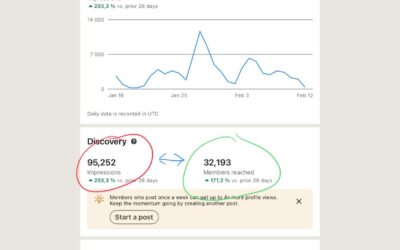
How many unique users and how many times have you truly reached with your LinkedIn posts?
This function has been added to LinkedIn just recently and some of you might not have it yet. In your Analytics dashboard on a private profile, you have a section called Post impressions (here is an URL). Choose data for the last 365 days. And here it comes: I see...