
This is 3.
published excerpt from the upcoming book How LinkedIn Will Change Your Life.
It follows the 2020 manual with over 12,000 readers. The book will be freely available for purchase and distribution, without asking for your contact details.
If you are interested in sending it in PDF form (tentatively mid-year), just write to me about it. So last time I wrote about the algorithm and at the end suggested that you don’t invest in paid advertising.
Now the promised reason why: because as someone who has been solving LinkedIn from morning to night for over 5 years, and with leading players in most European markets, I have never seen LinkedIn advertising deliver anything more than brand awareness. You can’t put brand awareness on bread – you need to generate real-world appointments for effect. Meetings are not made by the brandy, meetings are made by the people who represent the brandy.
Meetings are arranged by personal profiles via private messages, not by companies via paid advertising on their websites.
Now, you may have an ironic smile on your face because you’ve seen my company’s paid ad for StoryMatters.online.
Yes, we try a number of things that I don’t recommend here in this manual.
How else would we know they don’t work?
If you’re looking for a button through which you can run and control ads, you’ll find it at the top right under the Jobs tab.
There are also a lot of other buttons there that you often can’t find.
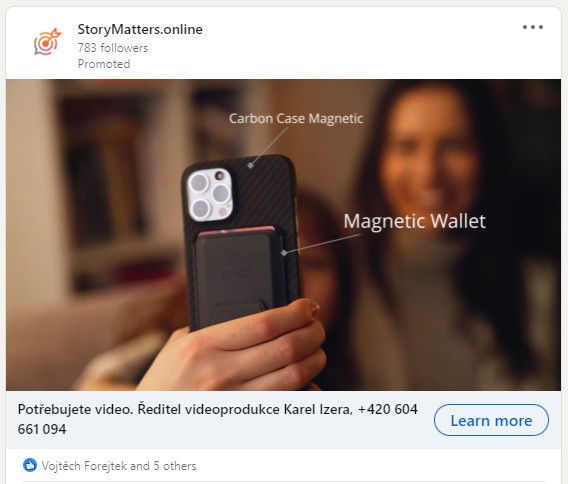
This is what our commercial 10 looked like.
– 14.03.2023 and it should be noted that on the basis of such posts without advertising we normally receive 5 – 7 inquiries per month.

And these are the results.
Zero inquiries.
LinkedIn is changing and we continue to look for ways to advertise.
So far what hasn’t worked much, let’s take a look together at the promised formats for organic non-advertising posts: 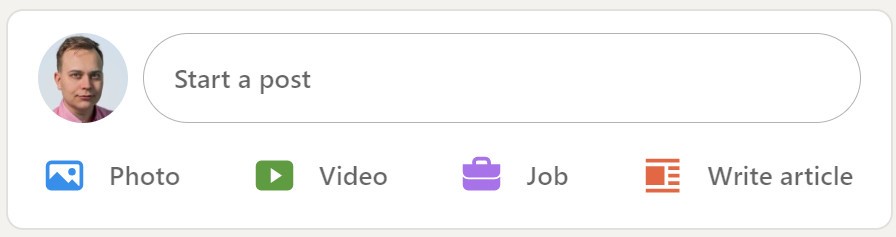
A number of post options are only revealed when you left-click on Start and post.
It will be the bottom bar with the grey icons.
Post in plain text form – it works and it’s a good idea.
Emoticons are an option, not a necessity.
It’s about expressing your personality in the working world, and here, emoticons are simply appropriate for some and not at all.
Remember, though, that people on LinkedIn can read.
What interests them professionally. Text with a photo – it usually doesn’t pay to publish two photos.
LI will just crop them ugly.
Otherwise, however, an illustration is always a good idea unless it is artificial ie.
It’s not an illustration.
Nowadays everyone has seen through that and it will have the effect on the viewer that you hide behind photos you have nothing to do with. Video – the best LinkedIn content. Not statistically, the number of views and similar metrics do not surpass images and text.
Not in preparation, in which video will always be the most challenging format.
It is the best emotionally.
Video best conveys you and your message.
Video makes the viewer remember you, and through video you have the best chance of persuading them.
How can we prove it?
Hardly.
Perhaps only one: by the hundreds of feedbacks that one receives only when one gets to a face-to-face meeting obtained through LinkedIn. The survey – if appropriately grasped, it is a great format.
It can be spoiled by a confusing question and a not very interesting topic.
However, if you ask a question that your target audience wants to know the majority opinion on, then that audience will vote.
Why?
Because you don’t get to know the opinions of others until you vote yourself.
And even after the vote, all anyone will know is the percentage distribution of each answer, not a specific roll call of who voted and how.
No one sees that.
Except you.
And we’ll cover how to work with that list in 2.
Chapter 2 of the upcoming book. Kudos, article, thesis, template – these formats generally have worse results than the above alternatives and therefore we don’t consider them productive. Newsletter – this is a series of articles.
And yet they write about articles not working.
Unless, well, unless you turn them into a newsletter.
Then suddenly they have magic: regular subscribers.
Let’s look at it properly: when you write an article, you have a one-time opportunity to announce to most people who follow your personal profile that it’s 1.
Part 1 of a series of articles on a common topic.
At the same time, you’re also announcing whether it will be a weekly regularity of articles, a 14-day regularity, or a monthly regularity.
This gives the person who follows you the opportunity to decide if they want to receive notifications about the release of a new “issue” in the long term.
If the interest is confirmed (which is typically 5 – 30% of those who follow your profile), then indeed the bell will usually ring that you have released a new article from the announced regular newsletter.
This is a really powerful tool.
Anyone who has ever encountered open rate statistics for email newsletters knows that an individual email open rate above 20% is a minor miracle.
With LinkedIn newsletters, big miracles are also common: 40 – 60%.
It’s a really good influence tool, and as of recently it also has at least a specificity: you know exactly who has decided to subscribe to the newsletter in the long term. Carousel – this is when photos or even videos alternate themselves in the post.
Now (March 2023) this format cannot yet be used by most users.
Unless LI artificially influences its algorithm in favor of a new format (which may happen), then we don’t expect a revolution from it. PDF – this is actually a carousel that you create yourself, and unlike the format above, the reader is expected to scroll through the slides themselves.
You create the carousel outside of LinkedIn, typically in Canva or PowerPoint.
It’s a successful format and there’s a lot of it on LinkedIn right now. It can be assumed that in the long run this format will become boring unless you give it your own unique flair with the help of good reportage photos and imaginative design. 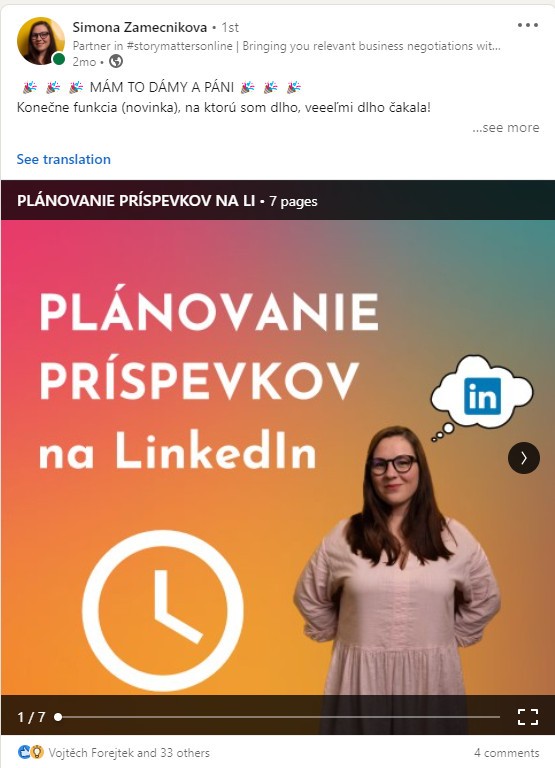
This is what a post with a scrolling PDF looks like in practice.
However, all of this largely goes to waste if you have a weak Social Selling Index on your profile.
So we’ll make that another topic for next week, shall we?